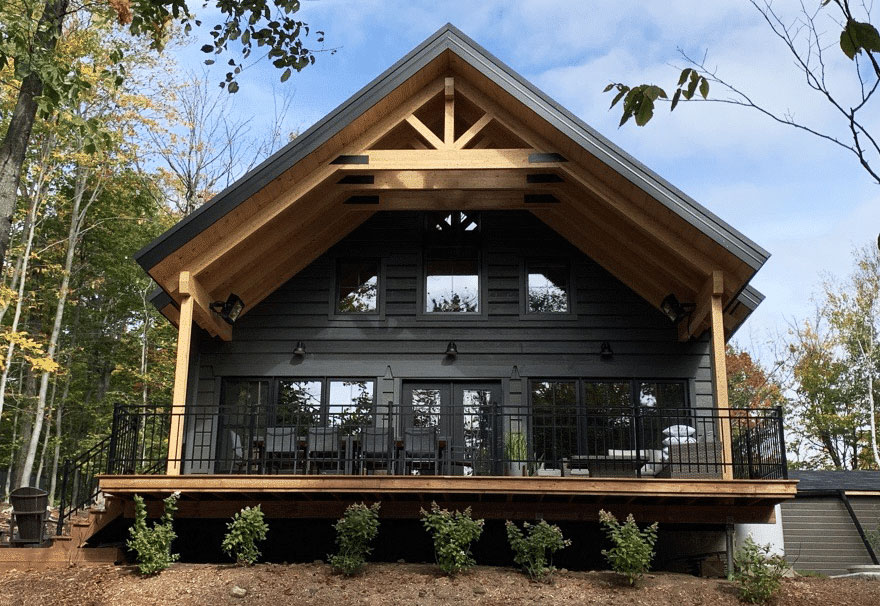

To preserve the beauty and durability of your wood building, an annual inspection of the condition of your stain, oil, or other coating is highly recommended. Here are some essential tips for effective maintenance.
Cleaning
Use water and mild soap to clean the exterior of the building. Regular cleaning helps maintain the appearance of your wood and removes deposits of dust, sand, and gravel.
Factors Influencing Stain Wear
- Prolonged sun exposure: UV rays can degrade the stain and affect the color.
- Constant contact with snow around the building (slab): Constant moisture can damage the wood and stain.
- Chosen tint: Darker colors can absorb more heat, which can accelerate wear.
- Accumulation of different particles (dust, sand, gravel): These elements can abrade the surface of the stain.
- Temperature at the time of application: Applying stain at extreme temperatures can affect adhesion and durability.
- Application method: Incorrect application can lead to premature wear.
- Product used: The quality of the product greatly influences the durability of the stain.
Protective Layer
We recommend applying a protective layer every 5 to 10 years. It is best to do this preventively rather than waiting for signs of degradation.
- Preparation: After a good cleaning with water, lightly sand the surface with 80-grit sandpaper to improve adhesion. Use a product compatible with the original stain for the application of the new layer.
- Frequency: Facades less exposed to wind and sun may require less frequent maintenance.
Resin and Wood Product Maintenance
Resin flow can be seen as an inconvenience of wood products, but it is also this characteristic of living wood that gives it its charm and many qualities. When it appears, resin can influence the appearance of your stain. However, once the resin has finished flowing and the new degree of crystallization is reached, it will no longer flow.
It is crucial to choose the right stain for your wood building. Do you prefer a look that might require a bit more maintenance or a lighter stain? However, it is important to note that very light shades, such as white, are also not ideal. Over time, wood knots can darken and stand out more than you want. Thus, both very light and very dark shades can require more maintenance.
According to trends and our clients’ achievements, even if these choices require more frequent maintenance, the final result can be spectacular and add considerable aesthetic value to your building. By considering these factors, you can make an informed choice that combines beauty and practicality for maintaining your wood.
Repairing Resin Flow
Although rare, resin can flow from some knots on the sun-exposed facade.
The pine used by Boréal is crystallized according to standards at a level of 160 degrees. Therefore, the resin will not flow until this temperature is reached. However, during very hot summers, a dark stain exposed to full sun can reach a temperature above this threshold, causing resin flow. As long as this new degree of crystallization is not reached, the resin will no longer flow.
Temperature and Staining Period: Ideally, perform the repair when the temperature is around 0 degrees Celsius at a minimum and around 10 degrees Celsius at a maximum during the day. The best times for staining are early in spring or during autumn.
For those who notice resin flow during summer, it is advisable to plan the repair either in autumn or early next spring, when conditions are ideal. Resin is very difficult to clean when conditions are not optimal, and stain is also finicky. It is strongly recommended to plan your repair if you notice problems during summer, but not to force things. By waiting for the ideal time, the repair will be trouble-free and the finish will be impeccable.
Here is how to repair these flows:
- Repair period: Preferably perform the repair in spring or autumn, when the temperature is between 0 and 10 degrees Celsius.
- Removing resin: Use a scraper or exacto knife to remove the dry resin.
- Sanding: Lightly sand the knot and the area to be repaired with 80-grit sandpaper or a Tynex brush from your Boréal kit to improve stain adhesion.
- (Extra) Applying B-I-N product: Make sure to sand the knot down to the natural wood for the product to be effective. Apply the high-quality B-I-N product from Zinsser, thoroughly rubbing the surface before applying it to critical areas.
- Primer product: Once the B-I-N product is applied and dry, apply a coat of opaque primer initially provided by Boréal.
- Stain: After applying the primer, you can apply your stain color on top.
By following these tips, you will ensure the longevity and beauty of your wood building. For any questions or additional assistance, do not hesitate to contact our customer service.
For more general tips, check out our article on spring maintenance.